Essential Documents for TG ECET Counselling 2025 - Student Checklist

Essential Documents for TS ECET Counselling 2025

If you plan to pursue engineering in Telangana through the Engineering Common Entrance Test TS (ECET) in 2025, it's essential to collect all the necessary documents for the counselling process. Counselling plays a crucial role in securing admission, and having the required documents ready will simplify the process. This article will guide you on the essential documents you need to bring for TS ECET 2025 counselling.


TS ECET 2025 Counselling Documents

Complete checklist of required documents

TS ECET-2025 Rank Card
TS ECET-2025 Hall Ticket
Aadhar Card
SSC Marks memo
Diploma Memo
Study Certificate from VI to Diploma
Transfer Certificate (TC)
Income Certificate issued on or after 01-01-2025
EWS Certificate issued by Tahsildar valid for the year 2025-26, if applicable
Caste Certificate issued by competent authority, if applicable
Residence Certificate of the candidate (if the candidate has no institutionalized education)
๐Ÿ“Š Document Collection Status
0
Collected

๐Ÿ“‹ Documents Collected:

No documents collected yet

During the TS ECET counselling, it is essential to carry all All Original certificates and 3 sets of Xerox copies. These copies are necessary for verification purposes and ensure a smooth counselling process. Make sure to organize and keep these documents safe, as they play a crucial role in securing your admission to engineering courses in Telangana.


For non-local candidates seeking consideration under unreserved seats, specific certificates must be submitted:

  • Residence Certificate: Applicants who have lived in the state for 10 years, or whose parents have, excluding periods of study or employment outside the state.
  • Employer Certificate: Candidates whose parents work for the state or central government, public sector corporations, local bodies, universities, or similar institutions within the state.
  • Additionally, minorities must provide an SSC TC containing minority status or a certificate from the headmaster.

Also watch detailed video on documents required along with importance of ROC form and income certificate

TS ECET 2025: Response Sheet and Answer Key

Response Sheet - TS ECET 2025

TS ECET Response Sheet 2024

Updated on 14-05-2025

TS ECET master question with key and response sheets were released today (14-05-2025), so candidates who are eagerly waiting can check them today. The last date for objections to the key paper is before 05:00 P.M. on 16.05.2025.
By comparing the answer key with your recorded answers, you can get an idea of your expected score. If you notice any mistakes in the answers, you can report them on the official website. In this article, we will give you more information about these steps.

What is ECET Response sheet ?

  • The TS ECET response sheet is a document that shows the answers selected by a candidate during the TS ECET exam. 
  • It helps candidates check their responses and compare them to the official answer key. 
  • By analyzing the response sheet, candidates can assess their performance and determine their chances of qualifying for admission.

TS ECET Response Sheets 2025

All the best!


  • The TS ECET 2025 response sheet is an important document for candidates who took the Telangana State Engineering Common Entrance Test (TS ECET). 
  • It contains the answers that candidates marked during the exam
  • Candidates can download the response sheet from the official TS ECET website and check if their recorded answers are correct. 
  • They can also use the response sheet along with the answer key to estimate their final scores
  • If candidates find any mistakes in the answer key, they can raise objections through the official website.
  • Here is the detailed article link how to raise objections on ecet key paper.

How to Raise Objections on TS ECET Key Paper 2025: Step-by-Step Guide

The TS ECET (Engineering Common Entrance Test) is an important test for people who want to join Btech after diploma. It's very important to make sure the test is fair and accurate when grading the candidates' answers. The people in charge of the ECET allow candidates to raise concerns about the answers in the Preliminary Key.

If you took the TS ECET exam in 2025 and want to challenge any of the answers in the Preliminary Key, 

Here's a step-by-step guide on how to do it effectively:

Use the Master Question Paper:

  • When you raise concerns, only use the Master Question Paper. During the test, the questions and options are mixed up by subject. So, to raise concerns accurately, use the Master Question Paper they provided.

Match the Question IDs:

  • Carefully compare the "Question id." (which has 11 digits) on your "Response Sheet" with the corresponding "Question id." (also with 11 digits) in the Master Question Paper for the specific subject. Only raise concerns about the options given in the Master Question Paper.
  • For example, if the Question id. on your Response Sheet is '12345678911', then consider the correct answer(s) for the same Question id. ('12345678911') in the Master Question Paper when raising concerns.

Identify Correct and Incorrect Options:

  • In the Master Question Paper, correct options are shown in green with a ✅ symbol, while incorrect options are shown in ❌with an X symbol. Pay attention to these visual cues to determine if the options are accurate.

Make a List of Concerns:

  • You can raise concerns about any number of questions, but only once. It's a good idea to make a list of all your concerns and the reasons for them before raising them online. Go to the "Objections on Preliminary key" section on the official website, "ecet.tsche.ac.in," to submit your concerns.

Justify Your Concerns:

  • Make sure each concern you submit is supported by a proper explanation. Concerns without a good reason will be rejected. Take the time to provide a clear and brief explanation for your concern, using relevant information from the Master Question Paper.

Key Comm ittee's Decision:

  • Remember that the decision of the Key Committee is final and will be used for grading. Once you've submitted your concerns, the Key Committee will review them and make a final decision based on whether the concerns are valid.

Submit Online on Time:

  • You can only submit concerns about the preliminary key online, and you must do it within the given time frame. Make sure to submit your concerns before 05:00 P.M. on 16.05.2025. They won't accept concerns submitted in any other way.

Follow the Format:

  • Follow the given format exactly when raising concerns. If you don't, your concerns may be rejected. Read and understand the guidelines carefully before submitting your concerns.
  • By following these instructions, you can effectively raise concerns about the ECET Key Paper for the 2025 exam. Make sure your concerns are well-justified and based on the Master Question Paper to ensure fairness and accuracy in the evaluation process. Good luck with your concerns, and I hope they are addressed satisfactorily.
  • Follow the link provided in this article and raise objections according to the rules mentioned in this article.


Raise Objections on ECET Key Paper 2025


How to Calculate Your AP Diploma Percentage: A Step-by-Step Guide

Are you an AP SBTET diploma student looking to calculate your percentage easily? Look no further than our tool created by Diploma Geeks! With our tool, you can check your percentage for all schemes and even understand detailed information with provided infographics.

Our tool allows you to calculate your percentage, including total marks, and you can even print it as a PDF for your records. 

Plus, if you've already checked your percentage, be sure to share this useful information with your friends.


AP Diploma Percentage Calculator

Percentage Calculation Result

Name:


Total Marks out of 3250:


Total Percentage:


Students performance evaluation - Information

  • If a student obtains 75% marks and above, it will be considered as First class with distinction.
  • If a student obtains marks between 60% and below 70%, it will be considered as First class.
  • If a student obtains marks below 60%, it will be considered as Second class.


AP Diploma Percentage calculator

How to calculate AP SBTET diploma percentage?

  • Visit our Diploma Geeks AP Diploma Calculator page.
  • Enter your name in the designated field.
  • Enter your marks semester-wise in the respective fields.
  • Click on the "Submit" button to calculate your percentage.
  • Finally, save the result as a PDF for future reference.
  • It's as simple as that! With our user-friendly tool, you can calculate your AP SBTET diploma percentage quickly and easily.

Do you want to calculate your AP SBTET diploma percentage by yourself instead of using online calculators? 

If so, just follow our easy-to-understand guide with step-by-step instructions.

The first step is to gather all of your marks for each semester. Once you have your marks, you can follow the guide below to calculate your percentage.

Calculate the total marks obtained:

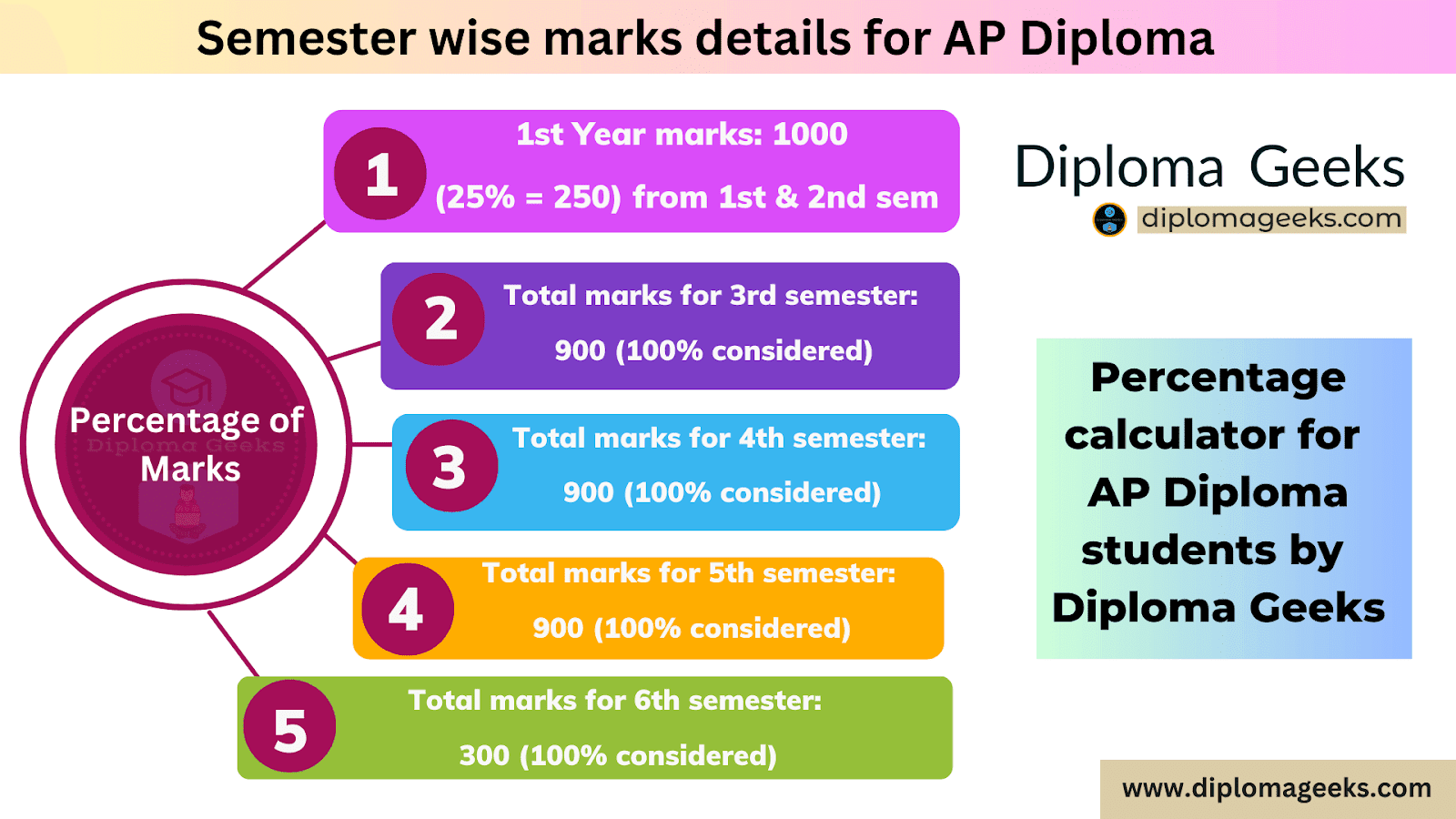
  • For your first-year marks, multiply your marks by 0.25 (which means 25% of 1000 will be considered (equals to 250 marks)).
  • For your 3rd, 4th, and 5th-semester marks, consider the total marks for each semester to be 900 and take 100% of it.
  • For your 6th-semester marks, consider the total marks to be 300 and take 100% of it.
  • Add up all the marks obtained to get your total marks.

Calculate the percentage:

  • Divide the total marks obtained by 3250 (total marks for all semesters combined) and
  •  multiply the result by 100 to get the percentage.

Using this method, you can calculate your AP SBTET diploma percentage manually without relying on an online calculator.

By following the steps above, you'll have a clear understanding of how your percentage is calculated, which can be helpful for future reference.

Useful Voter Resources for the 2024 Elections in Andhra Pradesh and Telangana

We've discussed about everything regarding voters in our video. In this blog post, you'll find all the helpful links you need. 

Happy voting!

Here is the list of useful links for 2024 Elections in Andhra Pradesh and Telangana

Category Links
Voter Slip Download ๐Ÿ”—
Voter Slip Download using Android App ๐Ÿ”—
Find my new EPIC ID Andhra Pradesh ๐Ÿ”—
Find my new EPIC ID Telangana ๐Ÿ”—
Download Voter ID Link ๐Ÿ”—
Our Informational YouTube Video ๐Ÿ”—

How to estimate TS ECET rank after checking the response sheet?

Recently, TS ECET response sheets have been released. Many students are asking, "How much rank can I expect?"

To estimate your rank based on previous year allotments, Follow the step-by-step procedure below, which will help you easily estimate your rank.

Step 1: Visit the ECET counseling website

  • As shown in the following image, search on Google for the TS ECET nic website. 

  • Then, click on the "College-wise allotment details" section. 


Step 2: Select the college name and branch

  • As shown in the figure, select the college.
  • Then, select the branch. 
  • Then click on "Show Allotments".

  • The previous year's data will be displayed.
  • So your main aim is to estimate your marks, so follow the next step.

Step 3: To know the allotted candidates, MPC marks, and branch-wise marks, follow these steps:

  • After displaying the allotted candidates list, copy their hall ticket number. 
  • Then, enter the hall ticket number in the TS ECET 2023 results page on the provided website link (the links will be provided at the end of the article).
  • In their results, you can check the marks obtained in the MPC (Mathematics, Physics, and Chemistry) subjects as well as the branch-specific marks.
  • Compare their marks with your marks and also compare the gender, caste & Region.
  • This way, you can easily estimate your rank and determine whether your marks are suitable for admission to that specific college or not.

Important Links:

Essential Documents and Checklist for TS ECET 2024 Exam

  • On May 6th, 2024, the ECET examination will be conducted.
  • To ensure that you are well-prepared for the exam, we have created a small checklist for you to review and pack in your bag.
  • Additionally, we have included a helpful instructional checklist that you can use as a guide. 
  • You can tick off the items as you verify them in your bag. 
  • This checklist ✅ serves as a reminder to help you stay organized. 
  • We wish everyone the best of luck!

Candidates must bring:


Important Instructions:


Exam Guidance for TS ECET 2023: Essential Exam Instructions, Valuable Tips and Tricks, and Required Documents

Nearly 18 minutes of a clear video explanation will effectively guide you for the exam.

TS ECET 2024: Eligibility, Syllabus, Exam Pattern, Important Dates and More

The Telangana State Engineering Common Entrance Test (TS ECET) is a state-level entrance examination conducted by Osmania University. This examination is designed for diploma holders and individuals with a B.Sc (Mathematics) degree who aspire to pursue B.E./B.Tech/B.Pharmacy courses offered by various colleges across the state of Telangana. In this article, we shall comprehensively address the eligibility criteria, exam pattern, syllabus, and fee structure for TS ECET 2024.

TS ECET 2023 - Updates & Information

Eligibility Criteria for TS ECET 2024

Candidates who wish to appear for TS ECET 2024 must fulfill the following eligibility criteria:

Nationality: 
  • The candidate must be an Indian citizen.
Educational Qualification for TS ECET: 
  • The candidate must have a diploma in engineering/technology/pharmacy from the State Board of Technical Education and Training of Telangana State or any other diploma recognized by the Government of Telangana as equivalent. 
  • Alternatively, candidates with a B.Sc degree in Mathematics from a recognized university are also eligible to apply.
  • Minimum Marks: The candidate must secure the following marks as per the given table to qualify for the examination. 
    Name of the Category Minimum Qualifying Marks (Out of 200)
    General 50 marks
    SC or ST no minimum marks required

Exam Pattern for TS ECET 2024

  • The TS ECET exam pattern consists of three sections, namely, Mathematics, Physics, and Chemistry. 
  • The exam will be conducted in online mode (computer-based test). The total duration of the exam is 3 hours, and the maximum marks are 200
  • The following table provides an overview of the exam pattern for TS ECET 2024
Subject No. of Questions Marks per Question Total Marks Duration
Mathematics 50 1 50 3 hours
Physics 25 1 25
Chemistry 25 1 25
Engineering (EEE, CSE, ECE MECH, CIVIL etc) 100 1 100

Fee Structure for TS ECET

The fee structure for TS ECET as per 2024 is as follows:
  • For SC/ST candidates: Rs. 500/- 
  • For all other candidates: Rs. 900/- 
  • The fee can be paid through online mode (credit card/debit card/net banking) or through TS/AP Online Centers/Citizen Service Centers. 
  • Candidates who wish to apply for the exam must pay the fee before the last date of submission of the online application form.


Download Syllabus Pdf's for TS ECET 2024

The following information will be updated soon.

TS ECET 2023 - Important Dates

S.NO Information Important Dates - 2023
01 Notification Released on 01.03.2023 (Wednesday)
02 Commencement of online Applications 02.03.2023 (Thursday)
03 Last date for TS ECET submission of online application i) Without Late Fee: 08.05.2023 (Monday)

ii) With Late Fee of Rs.500/-: 11.05.2023 (Thursday)

iii) With Late Fee of Rs.2500/-: 13.05.2023 (Saturday)
04 Correction of online application From 08.05.2023 (Monday) to 13.05.2023 (Saturday)
05 Download of TS ECET 2023 Hall Tickets 16.05.2023 (Monday)
06 Date of Examination TS ECET 2023 20.05.2023
09:00 AM to 12:00 Noon (Saturday)
TS ECET 2023 Important dates

Step-by-Step Guide on How to Apply for TS ECET 2023

Step 1: Application Fee Payment

The first step in the TS ECET 2023 application process is to pay the application fee. The application fee can be paid online using a credit card, debit card, or net banking. To pay the fee, follow the steps below:

  1. Visit the official website of TS ECET 2023.
  2. Click on the "Fee Payment" link on the homepage.
  3. Enter the required details such as name, date of birth, mobile number, and email ID.
  4. Choose the mode of payment and make the payment.

Step 2: Fill The Application Form

Once the application fee has been paid, the next step is to fill the application form. To fill the application form, follow the steps below:

  1. Visit the official website of TS ECET 2023.
  2. Click on the "Application Form" link on the homepage.
  3. Enter the required details such as personal details, educational qualifications, and contact details.
  4. Upload scanned copies of your photograph and signature as per the prescribed format.
  5. Check all the details entered in the form before submitting.

Step 3: Print Your Filled in Application Form

After submitting the application form, candidates must take a printout of the application form for future reference. To print the application form, follow the steps below:

  1. Visit the official website of TS ECET 2023.
  2. Click on the "Print Application Form" link on the homepage.
  3. Enter the required details such as registration number and date of birth.
  4. Click on the "Submit" button to print the application form.

Note: Candidates must keep the printout of the application form safe until the end of the admission process.

ECET Physics: ELECTRONICS

Doping in Semiconductors - in ECET Physics (Chapter Electronics)

 What is Doping in Semiconductors:

  • Doping is the process of adding impurities to a semiconductor material to change its electrical properties.
  • The impurities are usually atoms of another element with one extra or one less electron than the atoms of the semiconductor material. 
  • Doping can increase the number of charge carriers in a semiconductor, making it more conductive.

a. Extrinsic Semiconductors:

  • Semiconductors that have been intentionally doped with impurities are called extrinsic semiconductors. 
  • The impurities change the number of charge carriers in the semiconductor, which affects its electrical conductivity. 
  • Extrinsic semiconductors are used in electronic devices such as transistors and diodes.

b. P-Type and N-Type Semiconductors:

  • Doping can create two types of extrinsic semiconductors: p-type and n-type. 
  • P-type semiconductors are created by adding impurities that have fewer electrons than the atoms of the semiconductor material, creating holes in the valence band. 
  • N-type semiconductors are created by adding impurities that have one extra electron than the atoms of the semiconductor material, creating extra electrons in the conduction band. 
  • P-type and n-type semiconductors are used together in electronic devices such as solar cells, where they can generate an electric current by absorbing light.

Intrinsic Semiconductors - in ECET Physics (Chapter Electronics)

 Intrinsic Semiconductors

  • An intrinsic semiconductor is a pure semiconductor material that has a balanced number of electrons and holes at absolute zero temperature. 
  • Intrinsic semiconductors are important materials in semiconductor physics and device engineering, as they exhibit interesting electronic properties and are fundamental to the operation of many electronic devices. 
  • Examples of intrinsic semiconductors include silicon, germanium, and diamond.


a. Examples of Intrinsic Semiconductors:

  • Intrinsic semiconductors are pure semiconducting materials that have a balanced number of electrons and holes at absolute zero temperature. 
  • Examples of intrinsic semiconductors include silicon (Si), germanium (Ge), and diamond.


b. Concept of Holes in Semiconductors:

  • In a semiconductor, an electron in the valence band that has moved to the conduction band leaves behind a positively charged hole in the valence band. 
  • This hole behaves like a positive charge carrier and can move through the crystal structure by accepting electrons from neighboring atoms. 
  • The concept of a hole is important for understanding the electrical conductivity of semiconductors, as it allows us to describe both the movement of electrons and holes in the crystal structure.

Solar Cell - in ECET Physics (Chapter Electronics)

A solar cell is an electronic device that converts sunlight into electricity.

a. Principle of Solar Cell: 

  • A solar cell is an electronic device that converts sunlight into electricity. It is based on the photovoltaic effect, which is the generation of electric current when light falls on a semiconductor material. 
  • The semiconductor material used in solar cells is typically made of silicon or other similar materials. 
  • When photons of sunlight hit the semiconductor material, they excite the electrons and create electron-hole pairs. 
  • The electrons and holes are then separated by the electric field within the solar cell, creating a flow of current.

b. Applications of Solar Cell: 

  • Solar cells have many applications in both residential and commercial settings. 
  • They are commonly used to power homes, businesses, and other buildings. Solar panels can be installed on rooftops, walls, or in large solar farms. 
  • Solar cells are also used to power small electronic devices such as calculators, watches, and traffic signals. 
  • In addition, solar cells have been used to power satellites and other spacecraft, as they can generate electricity even in the absence of power source.

Light Emitting Diode (LED) - in ECET Physics (Chapter Electronics)

 Light Emitting Diode (LED):

LED symbol


  • An LED is a type of electronic device that emits light when a voltage is applied to it. 
  • LEDs are commonly used in electronic displays, lighting, and indicators because they are energy-efficient, long-lasting, and available in a range of colors.

a. Principle of LED:

  • The principle of LED is based on the phenomenon of electroluminescence, which is the emission of light from a material when an electric current is passed through it. 
  • In an LED, a semiconductor material such as gallium arsenide is doped with impurities to create a p-n junction. 
  • When a voltage is applied to the p-n junction, electrons and holes recombine, releasing energy in the form of photons, which produces light.

b. Applications of LED:

  • LEDs are used in a wide range of applications, including electronic displays, lighting, and indicators. 
  • They are commonly used as indicator lights on electronic devices such as smartphones, televisions, and computers. 
  • They are also used in traffic signals, streetlights, and automotive lighting. LEDs are preferred over traditional incandescent bulbs because they are more energy-efficient, longer-lasting, and emit less heat. 
  • They are available in a range of colors, including red, green, blue, and white, which makes them useful for a variety of applications.

PN Junction Diode - in ECET Physics (Chapter Electronics)

PN Junction Diode

 a. Principle of PN Junction Diode: 

  • A PN junction diode is a semiconductor device made of two layers, one with an excess of negatively charged electrons (N-type) and the other with a deficiency of electrons (P-type). 
  • When these two layers are brought together, the free electrons from the N-type layer move to the P-type layer, creating a depletion region with no free charge carriers. 
  • This forms a potential barrier that prevents further movement of electrons from the N-type layer to the P-type layer. 
  • When a voltage is applied across the diode in the forward direction, the barrier is lowered, allowing current to flow. 
  • In the reverse direction, the barrier is increased, preventing current flow.
P-type Semiconductor N-type Semiconductor
Contains impurities that create an excess of holes (positive charge carriers) Contains impurities that create an excess of electrons (negative charge carriers)
Majority charge carriers are holes Majority charge carriers are electrons
Has a higher concentration of positive charge carriers Has a higher concentration of negative charge carriers
Electrons in the valence band can jump into holes in the p-type material, creating a depletion region Electrons from the n-type material can jump into the holes in the p-type material, creating a depletion region
P-type material has a lower electron mobility N-type material has a higher electron mobility
P-type material is more easily oxidized N-type material is more easily reduced

b. Forward Bias and Reverse Bias: 

  • Forward bias is when a voltage is applied across a diode in the direction that allows current to flow. 
  • This lowers the potential barrier, allowing current to flow easily. Reverse bias is when a voltage is applied across a diode in the direction that prevents current flow. 
  • This increases the potential barrier, preventing current from flowing.

c. Applications of PN Junction Diode: 

  • PN junction diodes have many applications in electronics, including as rectifiers, voltage regulators, oscillators, and signal limiters. 
  • They are also used in solar cells, light-emitting diodes (LEDs), and photodiodes.

d. Diode as Rectifier: 

  • A rectifier is a device that converts AC voltage to DC voltage. A PN junction diode can be used as a rectifier by connecting it in series with an AC voltage source and a load resistor. 
  • When the diode is forward biased, it allows current to flow through the load resistor, resulting in a positive half-cycle of the AC voltage. 
  • When the diode is reverse biased, it blocks current flow, resulting in a negative half-cycle of the AC voltage. 
  • This produces a pulsating DC voltage across the load resistor. A filter capacitor can be added to smooth out the pulsations and produce a steady DC voltage.

Introduction to Solids - in ECET Physics (Chapter Electronics)

 a. Definition of Solids: 

  • Solids are one of the three states of matter, along with liquids and gases. 
  • In a solid, the atoms, molecules, or ions are arranged in a regular pattern and are held together by strong intermolecular forces, giving the solid a fixed shape and volume. 
  • Solids can be classified as crystalline or amorphous based on the arrangement of their atoms.


b. Energy Bands in Solids:

  •  In a solid, the electrons occupy discrete energy levels that are grouped together into energy bands. 
  • The valence band is the lowest energy band that contains electrons, while the conduction band is the highest energy band that is empty or partially filled with electrons. 
  • The energy gap between the valence and conduction bands is called the bandgap, and it determines whether the solid is a conductor, insulator, or semiconductor.


c. Valence Band, Conduction Band, and Forbidden Band:

  •  The valence band is the band of energy levels that contains the valence electrons, which are the electrons that participate in chemical bonding. 
  • The conduction band is the band of energy levels that are empty or partially filled with electrons that can move freely through the solid. 
  • The forbidden band, also known as the bandgap, is the range of energy levels that does not contain any allowed electronic states, so electrons cannot exist in this region.


d. Energy Band Diagram of Conductors, Insulators, and Semiconductors:

Energy Band Diagram of Conductors, Insulators, and Semiconductors:


  • Conductors have a small or no bandgap, which allows the valence and conduction bands to overlap. 
  • This makes it easy for electrons to move from the valence band to the conduction band, resulting in high electrical conductivity. Insulators have a large bandgap, which makes it difficult for electrons to move from the valence band to the conduction band.
  • This results in low electrical conductivity. Semiconductors have a moderate bandgap, which allows electrons to be excited from the valence band to the conduction band under certain conditions, resulting in intermediate electrical conductivity.


e. Concept of Fermi Level:

  • The Fermi level is the energy level at which there is a 50% probability of finding an electron. 
  • In a solid, the Fermi level separates the occupied and unoccupied energy levels. 
  • The energy difference between the Fermi level and the highest occupied energy level in the valence band is called the Fermi energy. 
  • The Fermi level determines the electrical and thermal properties of solids, such as their conductivity and heat capacity.

TS ECET Chemistry: Know the Importance of Chapter Wise Weightage

Are you getting ready for the TS ECET chemistry test? It's important to know which topics are more important and require more attention. This guide gives you a clear idea of the weightage of each chapter, allowing you to manage your study time and focus on the essential concepts. 

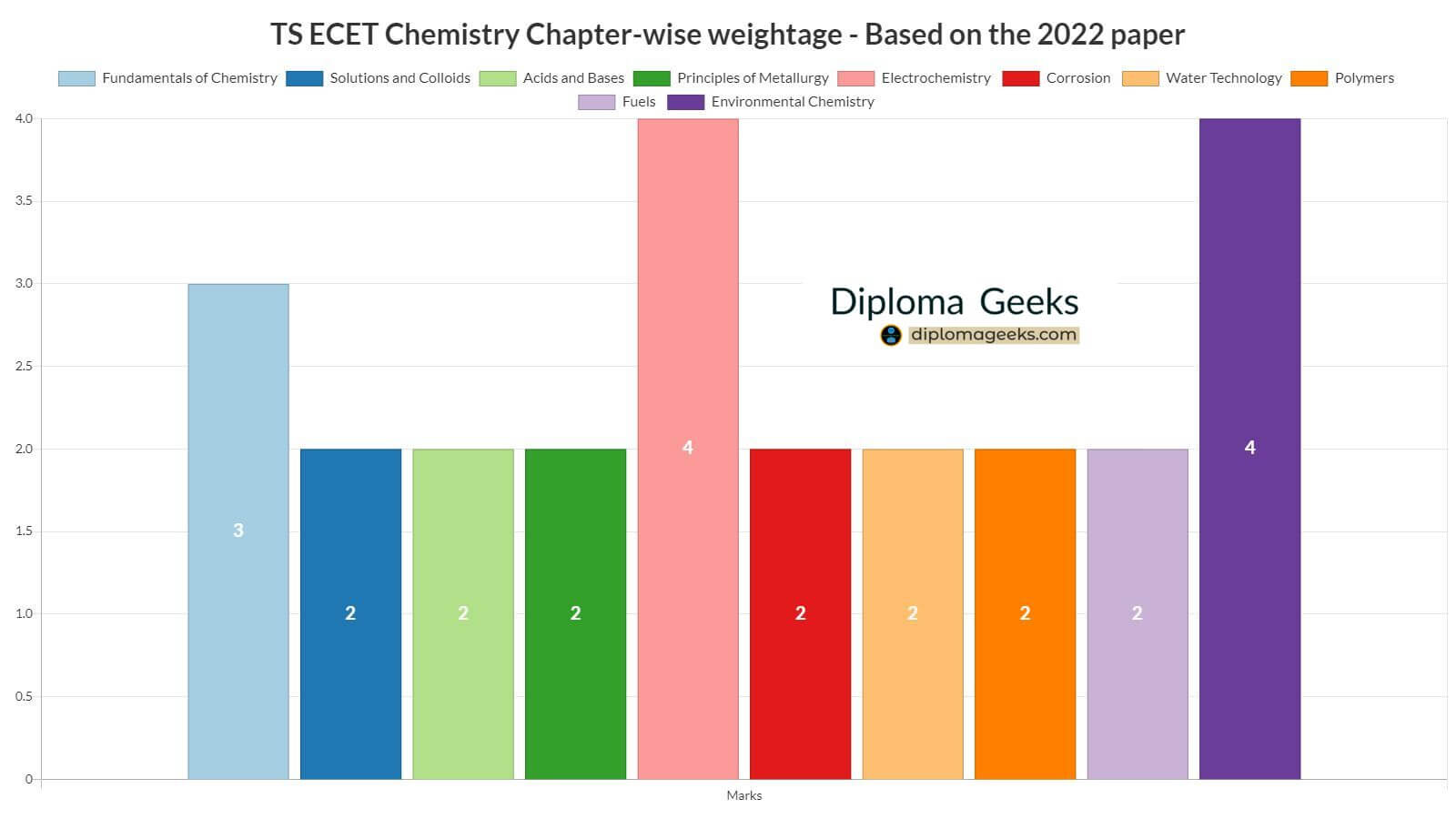
Chapter-wise weightage breakdown for TS ECET Chemistry

We have determined the weightage of each chapter based on the previous year's question papers. There are ten chapters in total, so review the breakdown below to study smarter.

TS ECET Chemistry Chapter Names Marks Weightage
Diploma Geeks - Analysis
Fundamentals of Chemistry 3
Solutions and Colloids 2
Acids and Bases 2
Principles of Metallurgy 2
Electrochemistry 4
Corrosion 2
Water Technology 2
Polymers 2
Fuels 2
Environmental Chemistry 4
Total 25

If you know the weightage of each chapter, you can organize your study schedule and concentrate on the chapters that carry more marks. This can improve your chances of getting a better score in the TS ECET chemistry exam. 

TS ECET Chemistry Chapter-wise weightage

Understanding the weightage of each chapter is essential to create an effective study plan. By focusing on the important chapters, you can increase your chances of success.